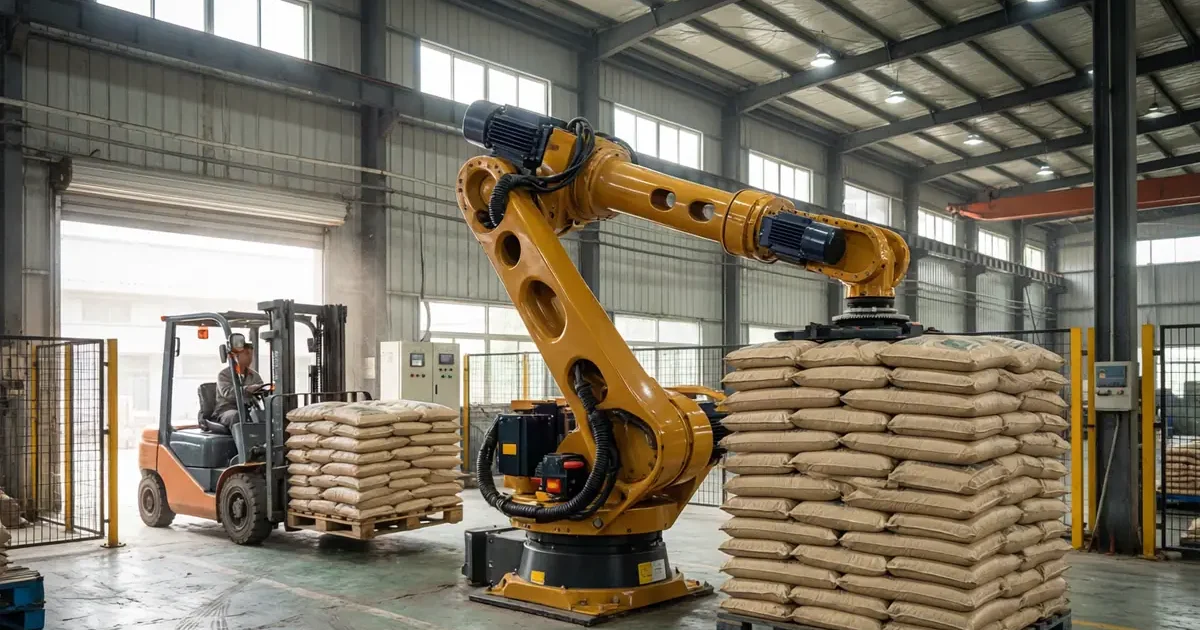
This is a composite of the fertilizer enquiries we handle most often — the same brief, the same constraints, the same fix, across several NPK and urea plants. Identifiers are removed; the numbers are the ones that matter.
The starting position
A plant running granulated NPK in 50kg woven PE bags and 25kg bags for a speciality line. Two baggers, four operators per shift on the pallet end, three shifts. Output was limited not by the baggers but by the pallet change and by the two people carrying rejected bags back to the sewing station. Stack collapse in the top layers on the 50kg pallets had already cost them two container loads.
What we asked for first
Before any machine selection: bag dimensions when filled (not the drawing), actual weight range including overfill, hourly output per bagger, pallet size and quality (their exchange pallets were 40mm warped, which shows up badly at the fifth layer), available floor area, ceiling height, and the fork-lift route.
Their real constraint turned out to be floor space, not speed. Anything that needed a wider cell was out.
The configuration
- Robot: a 4-axis 180kg palletizing arm on a raised pedestal, clearing the existing roller conveyor. The same class as our fertilizer bag stacker.
- Gripper: scissor-type with wide compliant pads for the 50kg woven bag, and an adjustable stop so the 25kg size runs off a stored pattern with a manual jaw-width change of about ten minutes.
- Infeed: a squaring stop and a back-pressure roller section, so the robot always received the bag in the same attitude. This alone recovered most of the rejected stacks.
- Pattern: row-lock for the 50kg line with interleaved slip sheets on the top three layers; column pattern for 25kg, which is stable enough and faster.
- Pallet handling: empty-pallet magazine with a lift-and-conveyor changer, so the pallet swap happened during the last layer instead of after it.
What moved
The plant did not gain bags per hour on the bagger — it never needed to. What changed was that the pallet end stopped being the constraint: the two carry-back roles were redeployed to quality checks, the shift handover stopped losing thirty minutes to a half-stacked pallet, and the collapse losses went to zero once the squaring stop and slip sheets were in. Measured over four months, shipped volume per labour hour improved by roughly a third, and that is the number their finance team cared about.
What we would do differently
Two lessons. The warped exchange pallets should have been audited before the pattern was fixed; we absorbed a stability problem that belonged to the pallet pool. And the compressed-air dryer was undersized for a humid site, which caused two valve failures in the first quarter that had nothing to do with the robot. Ask for the air quality spec as part of the design, not the install.
If you bag urea, NPK, MAP or DAP, the useful first step is a bag drawing with filled dimensions and your weight range. Send it to the quote desk, and read the fertilizer sector notes on how this machine class is normally fitted.