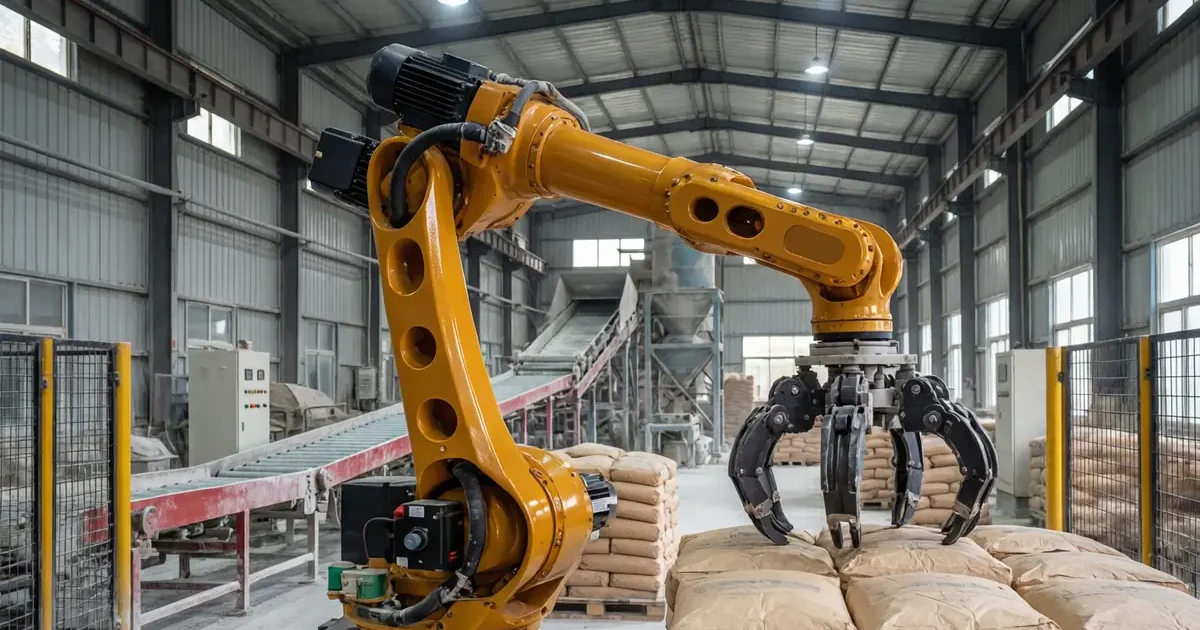
Cement and dry mortar are the toughest common palletizing duty in our order book. The bag is heavy, the product inside behaves like a liquid when it is freshly filled and like a brick after it sits, and the dust will get into anything that is not sealed. Machines that run perfectly on the test floor come back with complaints from cement plants for predictable reasons.
Fresh bags do not hold their shape
A bag filled five minutes ago has entrained air and the powder has not consolidated. It bulges, and it slumps when gripped. Two consequences:
- Grip geometry. A narrow lip pinches and splits paper valves; a wide flat jaw slips off the bulged seam. Scissor grippers with a compliant pad and a controlled closing stroke handle this best.
- Stacking settles. A layer pattern measured on a cold bag is wrong for a hot one. Build the pattern with the interlock the product will actually end up at, and let the machine square the layer rather than trusting the pick.
Where output allows, holding the bag for a short consolidation period before the pick solves more problems than a faster robot.
Weight is not the number that limits you
A 25kg or 50kg cement bag plus gripper is within reach of our mortar and cement bag palletizer, and a 180kg arm picks two bags comfortably. What limits throughput is the vertical travel to full pallet height while loaded, and the moment of inertia when the stack is at the far corner. Ask your supplier for the cycle time at your pallet height and your farthest corner, not the marketing figure quoted at mid-reach.
Dust protection is a specification, not a cleaning rota
- Sealed or purged electrical enclosures with a documented filter change interval.
- Cable dressing routed so it does not create horizontal surfaces where dust cakes.
- Grease points and reducer breathers located away from the bag stream.
- Air gun connections on the frame so the operator can blow down the pedestal without opening a panel.
- Bearing and seal materials rated for abrasive alkaline dust — cement is not neutral.
Also plan for the robot’s own cleanliness during maintenance. A machine whose panels open toward the bag stream will be re-dirtied every time someone services it.
Pattern and pallet choices that pay back
Row-lock patterns give the best stack stability for bagged cement without stretch film, at the cost of a slower layer. If your palletiser is film-wrapping anyway, a simpler column pattern is faster. Mixed-layer patterns look impressive and rarely survive contact with a change of bag supplier.
Standard European 1200×800 pallets and 1200×1000 exchange pallets behave very differently for a 50kg bag; getting this wrong costs you the top two layers of every pallet. Confirm the pallet your customers actually receive.
Where buyers get bitten
Three recurring causes: a suction gripper chosen for a dusty porous paper bag; no allowance for bag weight variation (a 25kg bag can arrive at 26.5kg); and the infeed not squaring the bag before the pick, which turns a precision machine into a precision machine stacking crooked bags. Fix the infeed first. It is cheaper than a bigger robot.
If you are stacking cement, mortar, gypsum or tile adhesive, send us the bag drawing, the bag weight range and your pallet size through the quote form. The building materials page shows how this fits with the rest of the range.