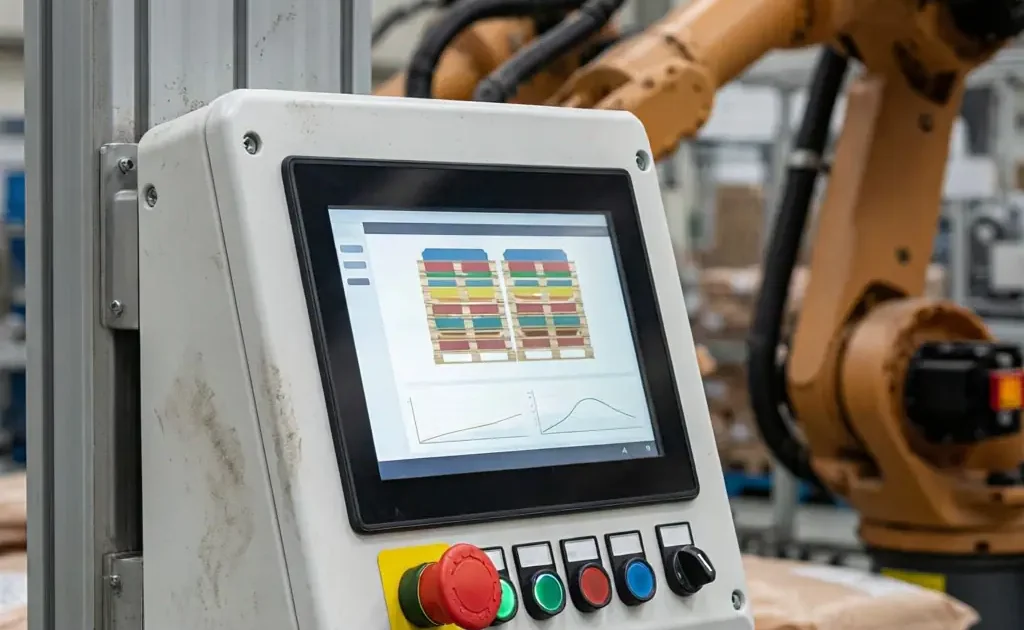
Buyers ask whether the machine has PLC control as if it were a feature checkbox. On a real palletizing line the PLC is not a feature; it is the part that talks to the rest of your plant, and it decides how painful the machine is to maintain five years from now.
What each controller is responsible for
A palletizing station normally has two brains, and confusing them causes most integration arguments.
- The robot controller runs the arm: kinematics, servo axes, path interpolation, and the stacking patterns. It cares about where the gripper is and how fast it gets there.
- The PLC runs the cell: infeed conveyor, bag accumulation and squaring, pallet magazine and pallet changer, safety gates and light curtains, the wrapping turntable, outfeed, and the signals to and from the upstream bagger. It cares about sequence, interlocks and fault handling.
The two exchange a handshake — typically ‘bag ready’, ‘pick allowed’, ‘pallet present’, ‘layer complete’, ‘pallet full’, plus an alarm word in each direction. A line that behaves badly at the pallet change is almost always a PLC sequencing problem, not a robot problem.
Why the PLC brand matters more than you think
Choose the PLC family your maintenance team already programs. Siemens S7 with a Comfort Panel is the most common request because its parts are available everywhere and the diagnostic buffer is readable by any automation engineer. Mitsubishi and Delta are widely specified in Southeast Asia where those brands dominate the installed base. Allen-Bradley makes sense if your site standard is Rockwell.
A machine with a PLC nobody in your plant can program becomes a call to the builder for every sensor change. Our PLC palletizing arm ships with the panel layout, the I/O list and the terminal schedule in the document pack for exactly this reason.
What the HMI is actually for
The operator screen should let a shift leader do four things without a programmer: select a stored stacking pattern, change bag size within the mechanical limits of the gripper, acknowledge and clear an alarm with the cause displayed in words, and start or stop the cell in the correct order. Anything else on the screen is engineering.
Ask to see the alarm list before you buy. A machine with numbered alarms and a 400-page manual hides problems; a machine with plain-language alarms and a timestamped history finds them.
Interlocks and safety
The safety circuit must stop the robot when a gate opens, hold it stopped until reset, and prevent restart with a pallet missing or a bag jammed. On palletizing duty this is the difference between an expensive machine and an expensive accident. Insist on a documented safety risk assessment, a category appropriate to your jurisdiction, and the safety wiring shown on the drawings you receive.
Questions worth asking a supplier
- Which PLC CPU, which HMI model, and which brand of servo drives — written on the quotation, not ‘equivalent’.
- Does your existing bagger’s signal list match the handshake, and who writes the interface document?
- Can the cell run with the robot isolated, so the line does not stop entirely while the arm is being serviced?
- Is the PLC program password-protected in a way you can legally undo?
- What happens to the pattern data if the HMI card is replaced?
If you send us your upstream machine’s signal list with your enquiry, we will return the interface table along with the price. The support page explains what we answer after handover.