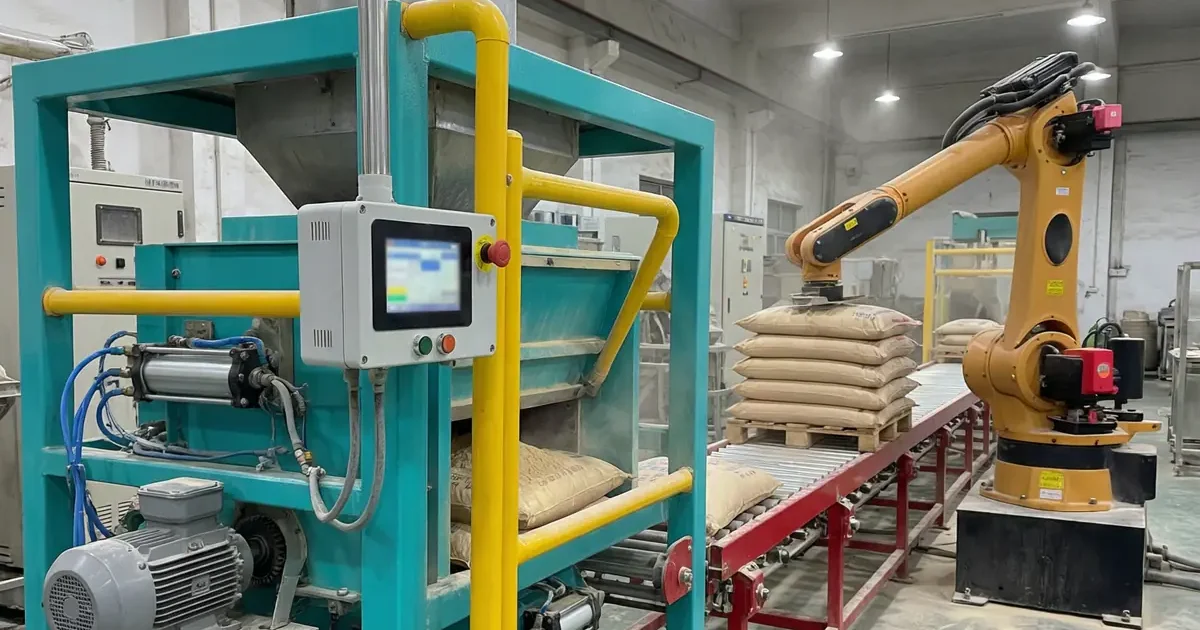
The bagging decision comes before the palletizing decision, because it fixes the bag the robot has to grip. Buyers who choose the packing machine on speed alone often end up paying for a stacker that cannot handle the resulting bag shape.
Open-mouth bagging
The bag mouth is held open mechanically, a spout or auger fills from above, and the top is closed by sewing, heat seal or tape. Works with woven PP, paper-laminated, kraft and PE liners, in pre-printed bags.
- Strengths: high accuracy on weighed fills, works with sticky or bridging products, the bag can be filled to a good density, and the seam can be inspected on line.
- Costs: more moving parts on the bag handling, and the bag supply (magazine or manual placement) sets the ceiling on rate.
- Best for: animal feed, seed, fertilizer granules, minerals, and any product where you want a weighed fill rather than a volumetric one.
Our full automatic open-mouth bagging machine is the model most often paired with a palletizing arm on feed and fertilizer lines.
Valve-mouth bagging
A valve sleeve is inserted into the bag neck and the product is blown or augered in under pressure; the bag fills on its own way and the valve closes behind it. Usually a woven or kraft valve bag, printed both faces.
- Strengths: very high rates on free-flowing powders, minimal bag handling, compact headroom, and excellent for cement, fly ash, mortar and fine chemicals.
- Costs: needs air pressure and a product that flows; valve bags are more expensive per unit; over- or under-fill is adjusted by flow time rather than by weight, so accuracy depends on the product being consistent.
- Best for: cement and dry mortar, fine mineral powders, some polymers.
What decides it
- Does the product flow? Bridging, oily or fibrous material pushes you to open-mouth.
- How dense is the fill? A valve bag of 25kg cement comes out brick-hard, which is ideal for gripperless handling but a poor shape for suction cups.
- Bag cost per tonne. Multiply your annual tonnage by the price difference between valve and open-mouth bags. On a 100,000-tonne plant this dwarfs the machine price gap.
- Rate needed. Above roughly 1,500 bags/hour on fine powder, valve mouth normally wins on economics.
- Presentation. Retail bags that must look square and be printed on all faces favour open-mouth with a stitched top.
Then think about the palletizer
The palletizing gripper specification follows from the bag the machine produces: valve bags are small, hard and dusty; open-mouth bags are larger, softer, and their seam is the weak point. Tell both suppliers the same numbers — filled dimensions, weight range, bags per hour, pallet size — and ask for the stacking diagram from the bagging vendor as well as the robot vendor. Mismatch between the two is the usual cause of a commissioning delay.
Send your product and bag preference to the quote desk. If you are not sure which bag you should be running, the industry pages show what each sector typically buys.