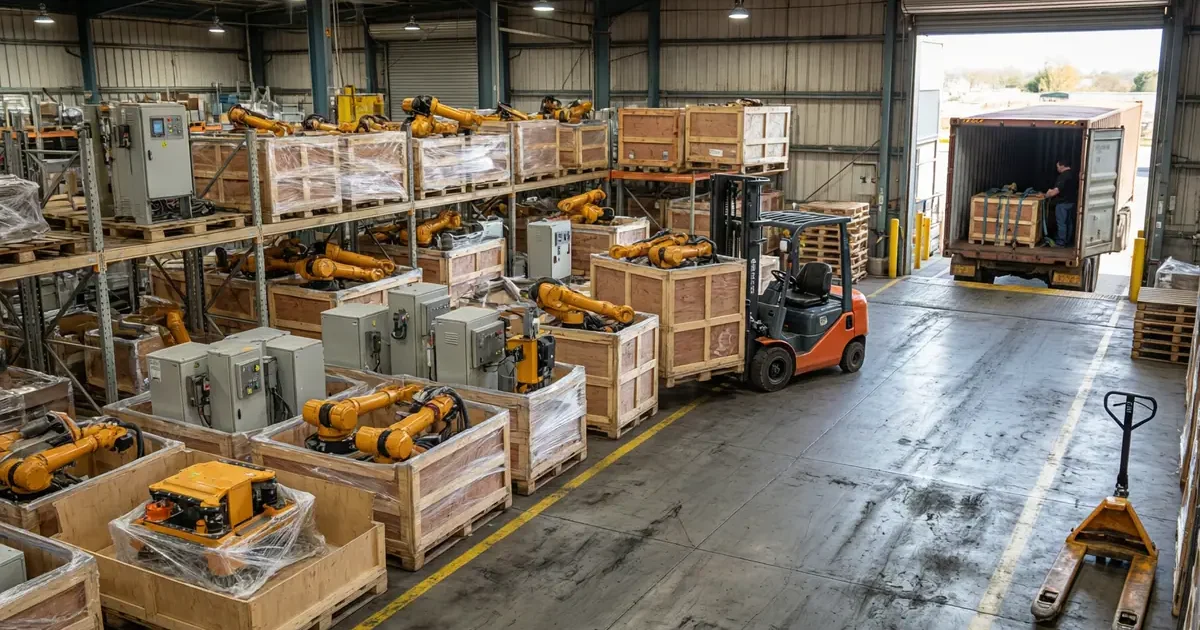
Asking about payback is the right way to buy a palletizer, and it is also where most calculations go wrong. Not because the arithmetic is hard, but because the labor line is underestimated, the gains are double-counted, or the cost side is only the machine. Here is how to build the number so it survives contact with your finance department.
1. Start with what the robot actually replaces
A palletizing robot rarely replaces one person. On a busy bagging line, the manual end of line typically runs two to four workers per shift lifting, squaring and stacking. The robot replaces:
- the heads on those positions, across every shift it covers;
- the recruiting and retraining churn, which in most plants is the real cost — bag-end positions have the highest turnover in the building;
- the injury exposure: repetitive lifting at 25–50 kg is the classic source of back claims and the premium that comes with them;
- the night-shift surcharge, if automation is what makes the second and third shift realistic at all.
Write the labor line as: positions × shifts × fully loaded cost. Fully loaded means wages plus insurance, meals, housing or transport allowances, and the recruitment overhead your HR department can quote you.
2. Count throughput gains honestly
A robot does not make the line faster than its bagging machine. What it does add:
- Uptime. Human stacking degrades over a shift; pace drops, malformed layers multiply, and the line stops for rework. A cell running a consistent pattern holds its rated rate all shift.
- Pattern density. Programmed patterns interlock bags tighter than hand stacking. On 25 kg bags this is typically two to five percent more bags per pallet layer — free logistics savings, every pallet, forever.
- Damage reduction. Fewer dropped and scuffed bags, fewer stretch-wrap rejects downstream.
Do not add a “capacity increase” line here unless you are genuinely bottlenecked at the bagging end and will run the extra output. Otherwise you are counting the same money twice.
3. Put the whole cost on the other side
The machine price is not the investment. As covered in our article on what drives palletizing robot pricing, infeed conveyor, pallet magazine, safety fencing, commissioning travel and spares commonly add as much again as the robot arm itself. Your investment line should include: equipment and gripper, freight and duty, installation and commissioning, operator training, and the first-year spare parts kit. Financing costs if you lease.
Against that, do not pretend the robot “runs for free” — include the running costs: power (a 4-axis cell draws roughly what a mid-size industrial air conditioner draws at peak, far less averaged), annual preventive maintenance, and consumables.
4. A worked example
A feed mill running two shifts, two workers on the bag end per shift, fully loaded cost of $7,000 per operator-year:
- Labor replaced: 2 × 2 × $7,000 = $28,000/year
- Turnover and retraining saved: ~$6,000/year
- Damage and wrap rejects: ~$4,000/year
- Total annual benefit: ~$38,000
Cell investment, delivered, installed and commissioned: $95,000.
Simple payback: 95,000 ÷ 38,000 ≈ 2.5 years — and materially less if a third shift is added, because the labor line scales with shifts while the investment does not.
5. What a good number looks like
For single-shift duty with low labor cost, payback of three to four years is normal, and the decision may genuinely be about injury risk and consistency rather than money. For two- or three-shift duty — which is where most of our customers in Southeast Asia and Latin America run — 18 to 30 months is the common range. If your calculation shows more than five years, check two things first: whether the labor line is fully loaded and covers all shifts, and whether the quotation includes the complete cell rather than an arm with the conveyor left out.
6. Getting a real number instead of a template
The variables that move this calculation are the same five facts that price the machine: bag dimensions, weight range, peak bags per hour, pallet size, and a photo of the space. Our XET series 4-axis palletizing robots from the 120 kg XET-120K to the 360 kg XET-360 cover the usual bag weights; the right class is the one that matches your duty, not the biggest number. Send the five facts through the quote form and we will return a priced cell layout — the honest input for the calculation above.