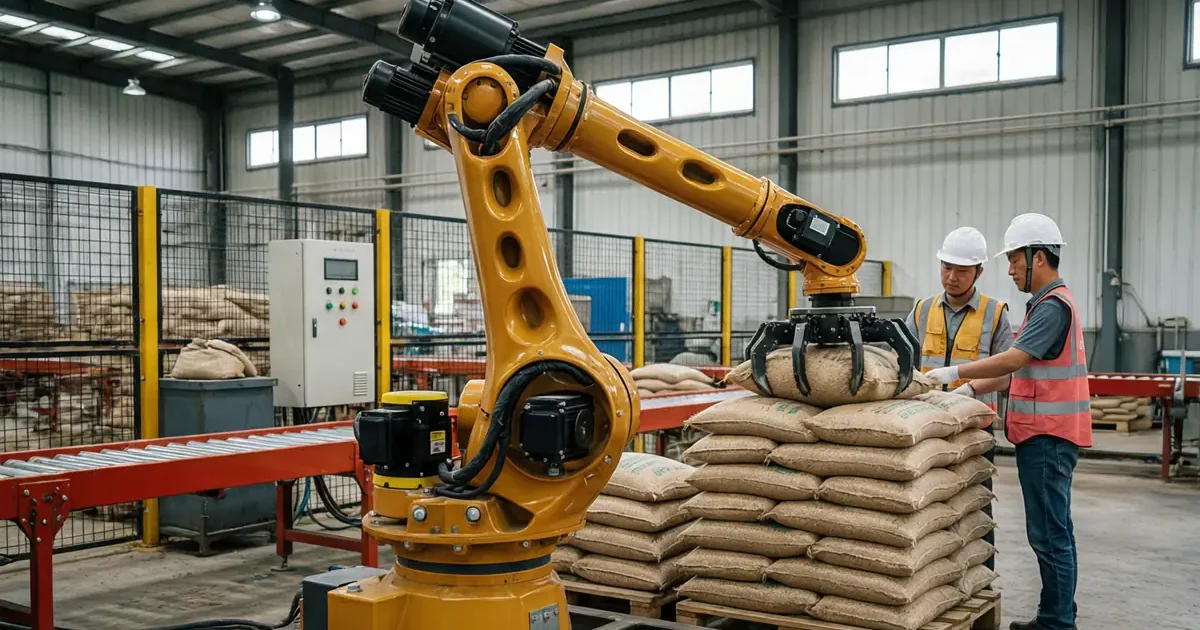
Feed milling is the friendliest entry point into robotic palletizing: one bag type, one pallet, high repetition, and a labour problem nobody enjoys solving by hand. It is also where the most machines are wrongly specified, because a bag of feed looks simple and buyers under-specify everything around it.
Start with the bag, not the robot
Write down the four numbers that decide the machine: bag dimensions, net weight, bags per hour, and pallet height. A 50kg paper-laminated feed bag at 740×420×130mm behaves completely differently from a 25kg woven PE bag of the same nominal weight. Woven bags are slippery, deform under grip, and shift in the stack; laminated paper holds an edge but tears if the gripper lip is too narrow.
Payload is bag weight plus gripper weight, multiplied by the number of bags picked per cycle. Two bags at 50kg with a 35kg gripper is 135kg at the flange, and with dynamic load you want headroom. That is why a 180kg-rated 4-axis machine such as our 180kg 4-axis robot palletizer is the common specification for double-bag pick-up, while single 50kg bags can be handled comfortably by a smaller arm.
Reach and footprint
Measure the actual distance from where the base will stand to the farthest corner of the tallest pallet, then add 10%. A 4-axis palletizer’s working radius is fixed by its arm geometry; a machine that is fine for a 1200×1000 pallet may not cover a 1200×1100 one at full stacking height without moving the pedestal.
Feed mills rarely have spare floor space. Tell your supplier the wall positions, the conveyor height, and whether a forklift route must stay open — the base can be raised on a pedestal or mounted on a rail to buy back space, but only if it is planned before the design is drawn.
Dust is the real enemy
Feed dust is abrasive and finds its way into everything. Ask specifically about: positive-pressure or purged electrical enclosures, cable dressing that does not form dust traps, air filters on the panel, and a robot arm whose grease points are sealed rather than open. Motor protection rating matters more here than speed.
Mistakenly, many buyers treat dust as a housekeeping problem. It is a specification item, and it changes the price.
Throughput and pattern changeover
State your bags per hour honestly, including peaks. A line running 800 bags/hour on two shifts needs a different cycle strategy than the same line running 400/hour continuously, because the robot’s constraint is not average speed but the pattern with the worst-case travel distance.
If you pack more than one bag size, the changeover question decides day-to-day usability. Grippers with adjustable stops and stored patterns in the HMI let an operator switch sizes in under fifteen minutes. Fixed grippers are cheaper and slower to change.
Gripper choice
- Scissor / flip bag gripper — best for woven and paper bags, gentle on the bottom seam.
- Suction cups — good on flat, rigid bags and boxes; poor on dusty, bulging or porous bags.
- Combination grippers — for mills that handle both bags and boxes on one pallet.
Send the supplier a real bag, or a video of it being handled. A specification built on a photograph of a bag that has been sitting in a warehouse since it was filled will be wrong.
What to ask for before you order
A stacking diagram for your own bag and pallet, the calculated cycle time against your peak rate, the component list with brand names, the electrical panel specification for a dusty environment, and a written lead time. Our quote team produces all five from the four numbers in the first paragraph — see also our feed industry solution and the PLC palletizing arm we most often install in feed mills.