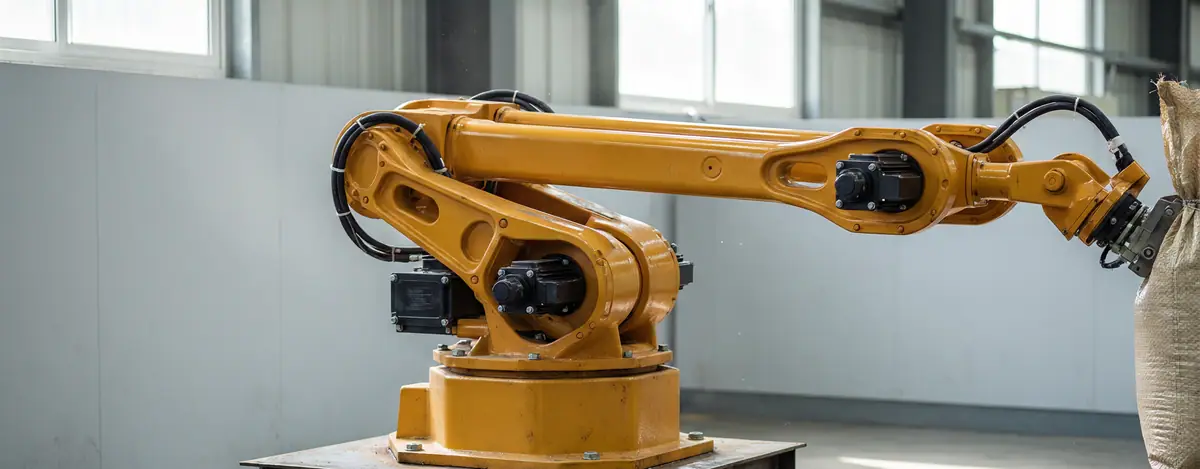
Almost every buyer we talk to has already heard one of two names. The honest answer is that ABB and FANUC are both capable of stacking your bags; the differences that matter commercially are local service coverage, spare-parts price, how much of the control layer you take over, and what your maintenance electrician already knows.
Where the two differ in practice
ABB
ABB’s palletizing arms are usually specified for the control architecture: the integrated MotionCoordinator and the packaged palletizing options handle multi-robot cells and mixed-layer patterns well, and ABB’s offline simulation is genuinely useful when you need to prove throughput before ordering. ABB has very wide dealer coverage in Europe, the Middle East and Latin America. Our ABB-integrated build is the ABB smart palletizing robot with touchscreen control.
FANUC
FANUC wins on longevity and on the discipline of its service documentation, and has the strongest presence in Southeast Asia and North America. Its palletizing packages assume you will accept the vendor toolchain, which is fine until you want to change something. FANUC arms hold their resale value well.
What the brand does not decide
Three things that determine whether the line keeps running have nothing to do with which logo is on the arm:
- The gripper. Bag handling is a mechanical design problem. Cup layout, lip geometry and compliance are what stop bags dropping or seams tearing.
- The electrical panel and the safety circuit. Component brands, terminal quality, spare fuses in the right amperages, and an emergency-stop chain your local inspector will sign off.
- Infeed and pallet handling logic. The robot is idle for a living line’s worth of seconds per layer while the pallet changes; masking that requires conveyor logic, not a faster arm.
A machine built around either brand will disappoint you if the integration is poor, and will run for a decade if it is not.
How to choose on your facts
- Ask which brand your nearest independent service company actually supports. A vendor office 900km away is worth less than a competent integrator 60km away.
- Price the five-year spares list, not the purchase order. Ask for battery, belt, encoder and reducer kit prices for each brand in your region.
- Match control layer to your staff. If your team will reprogram patterns weekly, choose the brand whose HMI they can learn; if the pattern is fixed for years, it hardly matters.
- Check lead time under your chosen Incoterm. A cheaper arm with a nine-week delivery to your port can lose to an in-stock build.
We integrate both, so the question we ask a new buyer is not which brand we prefer but which one your plant can maintain. If you already know, send the bag dimensions and your hourly rate through our quote form and we will price the same machine with either arm so you can compare on numbers. Our technical support page lists what is included either way.