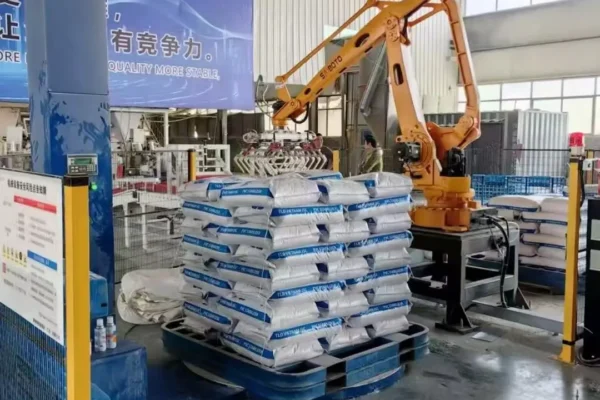
Cement and dry mortar plants run the hardest duty in our order book: 25kg and 50kg valve bags filled to brick hardness, alkaline dust that eats bearings, and pallets that must survive open-yard storage.
What we typically install
A valve-bag palletizing arm on a raised pedestal to clear the existing conveyor, stacking four or five bags per layer in a row-lock pattern, feeding a pallet changer and a stretch wrapper. The mortar and cement bag palletizer is the purpose-built version of this station; the multi-purpose automatic stacker is used where a plant also packs boxes or buckets.
Sector-specific problems we design around
- Fresh versus cold bags. A bag that has settled for an hour is smaller than one just filled. The pattern is built for the settled size, and the infeed holds the bag briefly where the layout allows.
- Alkaline abrasive dust. Sealed or purged enclosures, sealed grease points, and cable routing without horizontal surfaces that collect a dust cake.
- Warped exchange pallets. We audit the pallet pool before fixing the pattern, because a 40mm bow at the fifth layer looks like a robot fault and is not.
- Winter storage. Stacks held outdoors need interlocking and film; row-lock costs a few seconds per layer and saves the load.
Result we plan for
A bagging end that runs at the bagger’s rate instead of below it, with no rejected top layers. Read the detailed guide to palletizing cement and mortar bags, or see the palletizing range for the machine classes.