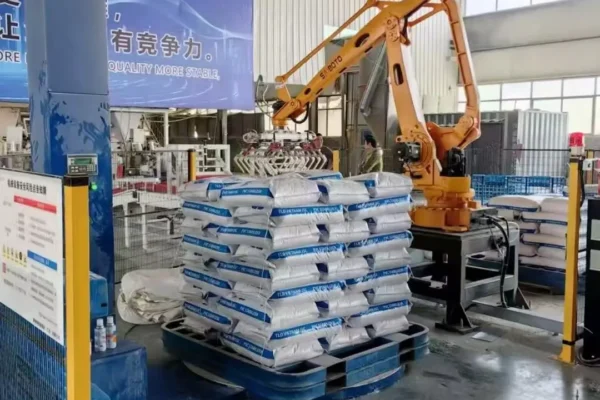
Food and beverage plants palletize cases, trays and shrink-wrapped multi-packs rather than bags, which changes the whole specification: higher layer counts, lighter loads, tighter tolerances on the finished stack face, and a cleaning regime the machine must survive.
What we typically install
Four to eight layers per pallet at 1,200–2,000 units per hour, picked as a full layer from a grouping table rather than unit by unit. Suction grippers with food-grade cups are the default, and where a line runs both cartons and shrink-wrapped bottles, a combination gripper avoids a manual changeover — the vacuum gripper palletizer is the build used for mixed case and pouch work, and the ABB smart palletizing robot covers lines that want integrated multi-robot control.
Sector-specific problems we design around
- Washdown and humidity. In coolers and bottling halls the atmosphere is wet and sometimes corrosive. We specify stainless fasteners, sealed cable entry, and a pedestal that drains rather than ponds water.
- Product presentation. Retail cases must show a clean face. Pattern programming keeps labels oriented, which a general-purpose stacker left to itself will not.
- Changeover frequency. SKU churn is constant. Stored patterns and quick-change cups are worth more here than a faster arm.
- Foreign-object and hygiene review. No loose plastic, no grease points above the product path, and cups that can be removed for sanitation without tools.
Result we plan for
A pallet end that keeps up with a fast filler without a third shift, and stacks that survive a distribution centre’s handling. Compare machine classes on the palletizing range, and read our note on choosing bagging kit where the line packs pouches.