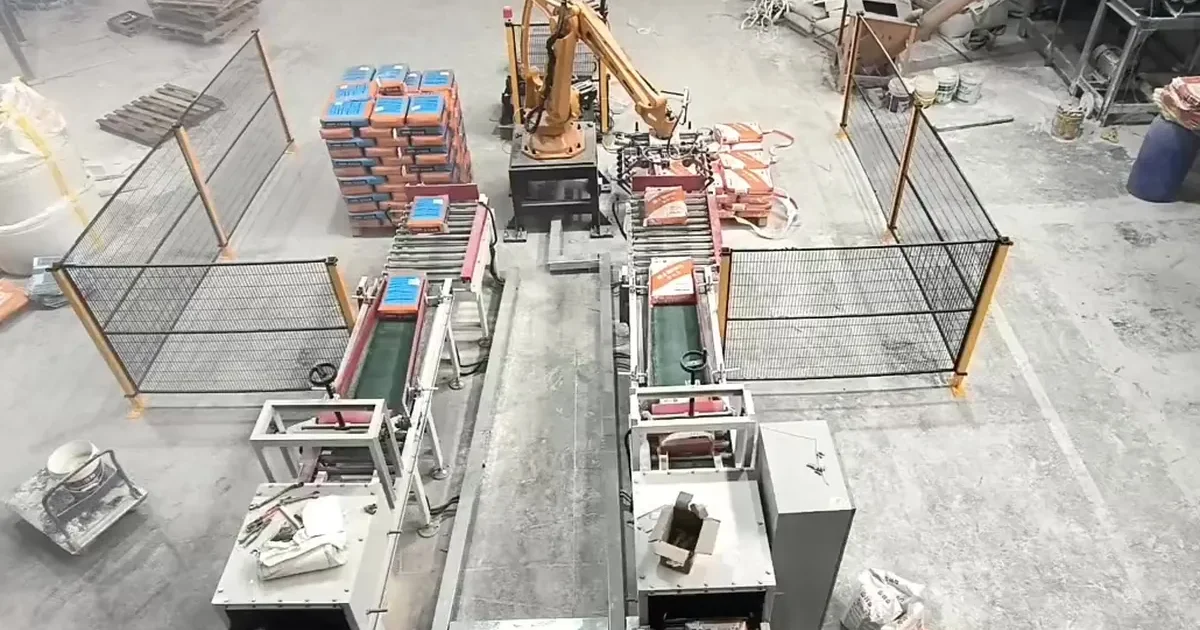
A bag line can be palletized two ways: a mechanical layer-former that squares up a whole row and drops it as one layer, or a robot arm that picks a bag or a bag pair off the infeed and places it where the pattern says. Both are mature machines. The choice is not about which one looks modern. It is about how many products you run, how steady your throughput really is, and who has to keep it going at two in the morning.
1. How each machine builds a pallet
A layer-former accumulates bags in a lane until a full row exists, squares that row against a backstop, tips it onto a shelf, then drops the complete layer onto the pallet. Every bag goes through the same forming geometry, so layers come out square and repeatable. A robot has no forming station at all: the gripper lifts a bag or a two-bag group off the conveyor and puts it at a programmed coordinate. The pattern lives in software, so the arm can start layer three beside the last bag of layer two if that is what the interlock needs.
2. Where the mechanical palletizer still wins
Sustained rate on a single product. Forming happens in parallel with the layer drop, so a well-built former holds a fixed cycle no matter how many bags make up a layer, and it does not slow down when the pattern gets complicated. It also produces a tighter layer edge on free-flowing material, such as grain, sugar or flour in paper and kraft bags, where a placed bag can bulge outward. If you run one bag size and one pattern, and the building was designed around that duty, a former is usually the cheaper way to buy bags per hour.
3. Where the robot wins
Changeover and mixed loads. Going from a 25kg valve bag to a 50kg open-mouth bag on a former means adjusting guides, backstops and the forming lane, and sometimes changing parts. On a robot it is a recipe: another gripper tool and another pattern file. One arm can also serve two or three discharge lanes that a single forming station cannot reach, and it can build a mixed pallet, two SKUs or product interleaved with case layers, which a former simply cannot do. Layout is the other reason. The arm needs a fenced envelope but no long infeed run, so the cell can fit the building you already have instead of dictating a new one.
4. The five numbers that decide it
Write these down before you let anyone quote you. Average bags per hour across a full shift, not the peak you watched during a test run. How many bag sizes and pallet patterns the same machine must handle in a month. Full bag weight and dimensions, and whether the bag holds its shape or slumps. Target pallet height, and whether you need tie sheets or corner boards. The floor area and column spacing you can genuinely give up. The first two point at speed. The other three usually decide whether this is a robot job or a former job.
5. What flexibility costs you afterwards
A robot buys pattern freedom and pays for it elsewhere. The gripper becomes both a design item and a wear item, cycle time now depends on the pattern because more picks per layer means more picks per hour, and the cell needs a real safety envelope: fencing, interlocked gates and a light curtain at the pallet position. A former has fewer degrees of freedom but more fixed machinery, such as forming chains, tipper, shelf lift, empty-pallet magazine and full-pallet conveyor, and every one of those is a mechanical adjustment someone on your night shift has to understand. Both need a spare-parts plan. We name every component on the quotation and run a witnessed eight-hour hot test before shipment, as set out on the support page.
6. Three mistakes we see most often
First, sizing the arm for peak rate and then never running at it, which means paying for payload that sits idle. That is the same trap described in what drives palletizing robot cost. Second, ignoring bag variation: a re-sewn woven bag, or a paper bag whose corners sit differently after filling, changes pick reliability more than any control upgrade does. Third, forgetting the two ends of the cell, meaning empty pallets in, full pallets out, tie sheets, and what happens when the discharge jams. That is where most of the downtime lives, and it is where a quotation that looked cheap quietly stops being cheap. If the bag type is still open, open-mouth versus valve-mouth bagging covers how that choice moves downstream.
7. The short version
One product, one bag, a high steady rate and a plant that maintains mechanical equipment well: buy the former and spend what you saved on the infeed. Several products, mixed pallets, a building you cannot re-cut around a long forming lane, or a line that must keep running through a bag change: buy the robot and buy the gripper engineering with it. Send bag weight, bag dimensions, bags per hour and pallet height through the quote form and we will tell you which of the two we would build for those numbers. Choosing between ABB and FANUC arms is a separate decision; the electrical side is covered in PLC control in palletizing robots.